AI and Physics-Based Modeling: A Force Multiplier for the Future of Hardware

What if an aerospace company could test dozens of design variations overnight instead of waiting months for wind tunnel results? What if the insights from those tests could be applied instantly—accelerating the rate of continuous improvement by magnitudes? Because designs can always be improved. With AI-driven simulation, products developed in the same timeframe as traditional methods wouldn’t just be faster to market—they’d be exponentially better. What once took months or even years to refine could now be optimized in weeks or even days, unlocking a new era of engineering innovation.
This convergence of AI and physics-based modeling is one of the most promising frontiers in deep tech. And it’s a massive opportunity for a new wave of startups creating purpose-built applications, vertical solutions, or integrations with existing design and simulation software.
The Problem with Traditional Simulation
Designing high-performance components—whether it’s a propeller, turbine blade, or aerodynamic car body—is a process of continuous refinement. Engineers tweak designs by adjusting geometry, curvature, and structure to optimize efficiency and durability. But every change must be simulated and validated—and today’s simulation methods are painfully slow.
Take a propeller blade for an electric aircraft: A slight change in tip shape or twist angle could boost efficiency by 2-3%. Yet testing that small improvement requires:
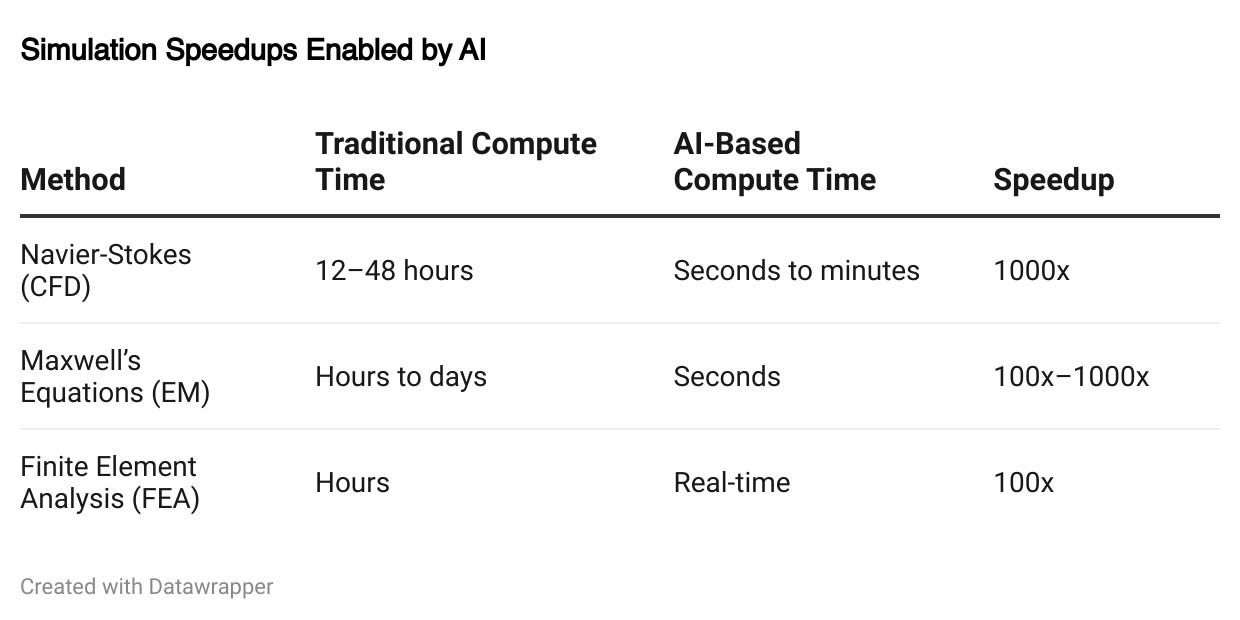
A high-fidelity computational fluid dynamics (CFD) simulation (24-48 hours on high-performance computing, or HPC).
A new physical prototype (weeks and thousands of dollars).
Wind-tunnel testing (weeks or months to schedule).
As a result, teams often batch-test changes, sacrificing clarity about which tweak delivered what improvement. Suboptimal decisions make it into production, compounding inefficiencies across future product generations.
The Solution: Physics-Informed AI
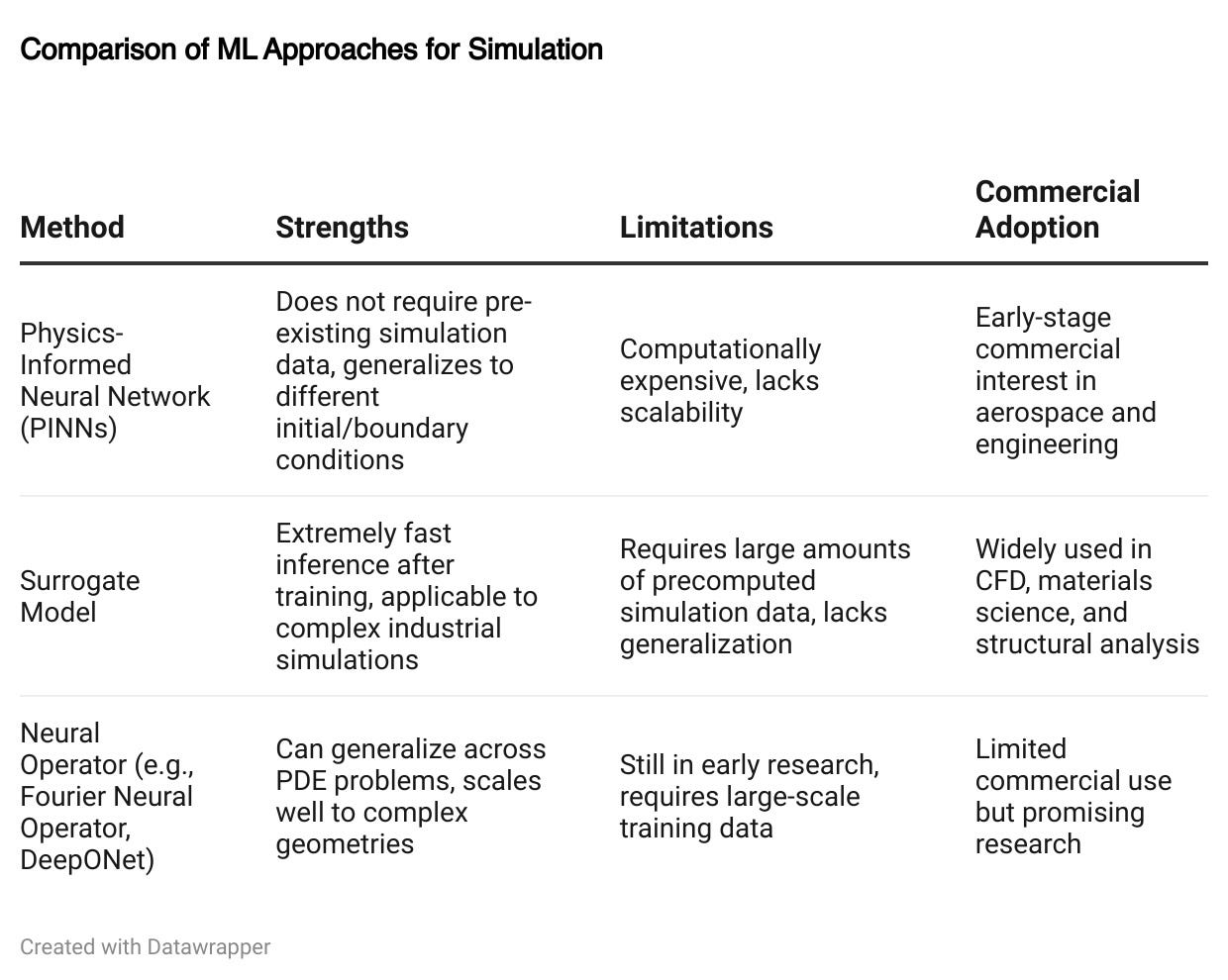
Recent advances in machine learning (ML) now allow simulations to be accelerated, scaled, and even generalized across different problem sets. In particular:
Physics-Informed Neural Networks (PINNs) embed physical laws into the loss function of a neural net, solving complex partial differential equations (PDEs) without requiring labeled data.
Surrogate Models use ML to approximate outputs of expensive simulations, enabling real-time inference.
Neural Operators learn mappings between entire function spaces, generalizing across geometry and boundary conditions.
For example, consider the Navier-Stokes equations that govern fluid dynamics. These partial differential equations model the motion of fluid substances and are notoriously complex, especially in turbulent regimes. One form of the Navier-Stokes equations in vector notation is:
Here, u is the velocity, p is pressure, ρ is density, ν is viscosity, and f represents external forces. Solving these equations over high-dimensional geometries with varying boundary conditions is computationally intense—sometimes requiring days of HPC runtime.
Machine learning approaches aim to bypass or accelerate these calculations by learning the solution space directly or approximating the operator that maps input conditions to outputs.
Generative Design: AI in the Early Stages
Before running simulations, product development teams are also using AI in the hardware design process. Generative design tools use ML to produce thousands of design options that satisfy constraints such as weight, strength, material, and cost. Topology optimization then removes unnecessary material from a structure while preserving function.
But most generative design tools stop short of manufacturability. That’s changing with the rise of AI-enhanced workflows that integrate computer numerical control (CNC) machining, casting, or additive manufacturing constraints directly into design. When paired with AI-powered simulation, the result is a closed-loop design process—from concept to manufacturable, optimized part—that takes hours rather than weeks.
Real-World Use Cases and Industry Applications
AI-powered physics modeling is already being adopted in industry and is demonstrating tangible value. Whether it's helping major automakers streamline vehicle aerodynamics, enabling hypersonic flight research, or discovering next-generation materials, these tools transform how engineering teams work. Below are several real-world use cases and application areas where PINNs and AI-driven CFD simulations are making an impact:
PINNs for Aerodynamics and Turbulence Modeling
Traditional CFD solvers for fluid dynamics problems—such as airflow over an aircraft wing or around a car—rely on discretizing space into millions of grid cells and solving the Navier-Stokes equations at each point. This approach is highly accurate but computationally expensive, particularly for turbulent or transient flows. PINNs offer an alternative by embedding these same governing equations directly into a neural network’s loss function, allowing the network to learn the fluid behavior while respecting physical laws. This enables faster, more adaptive simulations that can update in near-real-time as design changes are introduced, enabling engineers to test many more design variations in the same development window. The result is faster, cheaper design optimization for vehicles, aircraft, and even wind turbines.Hypersonics & Plasma Physics – PINNs for Extreme Flow Conditions
Hypersonic flight introduces extreme physics challenges—shock waves, plasma formation, and rapid heat transfer all occur simultaneously, creating coupled multi-physics problems that push traditional solvers to their limits. PINNs offer a breakthrough by learning solutions across these coupled domains, where data is sparse, and traditional approaches often break down. With the ability to handle both the fluid dynamics of hypersonic flow and the complex interactions between the vehicle surface, atmosphere, and plasma sheath, PINNs are becoming a key tool for both defense and commercial aerospace programs exploring next-generation hypersonic systems. Faster simulation times also allow more design iterations, helping accelerate the path from concept to flight-ready technology.Physics-Guided Material Discovery – Faster Discovery and Optimization
Developing new materials traditionally involves a slow, iterative process—combining physical experiments with computational simulations like Density Functional Theory (DFT) or molecular dynamics. These methods, while accurate, are resource-intensive and time-consuming. PINNs accelerate materials discovery by embedding physical laws—such as energy conservation and thermodynamic principles—directly into AI models. This enables:
Predicting material behavior under extreme conditions (temperature, pressure, stress) with fewer training samples.
Inferring missing properties from sparse experimental data by combining physics with known datasets.
Exploring rapid compositional and structural design spaces faster by reducing the need for exhaustive physical testing.
For industries such as aerospace, automotive, and manufacturing, this means discovering lighter, stronger materials optimized for real-world applications months or years faster than traditional approaches.
Additive Manufacturing (3D Printing) – Smarter Process Optimization
Beyond material discovery, AI-driven simulations are transforming the manufacturing process itself. In advanced manufacturing, physics-informed AI is used to optimize production techniques, such as casting, injection molding, and CNC machining, ensuring parts are manufacturable without costly trial and error. PINNs can predict thermal stresses, deformation, and failure points in real time, allowing engineers to refine manufacturing parameters before production begins. This results in:
Lower defect rates by predicting and mitigating production flaws in advance.
Reduced material waste, lowering costs and improving sustainability.
Shorter production cycles, accelerating time-to-market for new products.
As AI continues to integrate into manufacturing workflows, companies can develop more precise, reliable, and cost-effective production processes—particularly in high-performance industries like aerospace and medical devices.
AI-Accelerated Aerodynamic Simulations for Vehicle Design
Automotive manufacturers are leveraging AI-driven CFD simulations to optimize vehicle aerodynamics more efficiently than ever before. Traditionally, refining airflow characteristics—such as underbody drag reduction or cooling airflow through a grille—required multiple rounds of wind-tunnel testing and high-fidelity CFD simulations, each taking weeks. With AI-enhanced simulations, companies like Tesla and BMW can evaluate thousands of micro-adjustments in hours, dramatically reducing design cycles.
By integrating AI into their aerodynamic design process, automakers can:
Reduce drag and energy consumption, extending electric vehicle range.
Optimize cooling systems for better thermal management.
Improve handling and stability by refining airflow around a vehicle's body.
With faster, AI-driven iteration, the auto industry is seeing shorter R&D timelines, more efficient designs, and significant cost savings—making AI-powered simulations a competitive advantage in vehicle engineering.
Simulation Speedups Enabled by AI
Where Founders Can Build
There is a whole generation of companies about to be built in this space and they won’t just apply these models; they’ll build the tools and infrastructure that make them easier to use, faster to deploy, and more reliable in critical applications.
AI-native simulation accelerators for CFD, FEA, EM, or multi-physics.
Design-to-manufacture platforms that integrate generative design with AI simulation.
Verticalized toolkits for aerospace, defense, automotive, and industrial manufacturing.
Data orchestration layers that standardize legacy simulation data to train AI models.
Physics model hubs to provide verified PINN/Neural Operator models for common PDEs.
Enterprise customers won’t rip out workflows overnight. Founders who embed into existing pipelines, offer speedups, or enable new use cases will find early traction. Startups that partner with entrenched players like ANSYS, Siemens, and Dassault will have an easier time getting customer penetration and product feedback.
The Opportunity
AI-driven simulation and generative design represent not just a 10x improvement in engineering workflows—they’re a force multiplier. The ability to test more ideas, faster, with more fidelity compounds over time. Like continuous integration and delivery did for software, this unlocks a new speed of hardware development.
If you're building here—or want to be—I’d love to connect. Calibrate Ventures is actively exploring this space and backing the founders driving it forward.
Let’s talk. 🚀